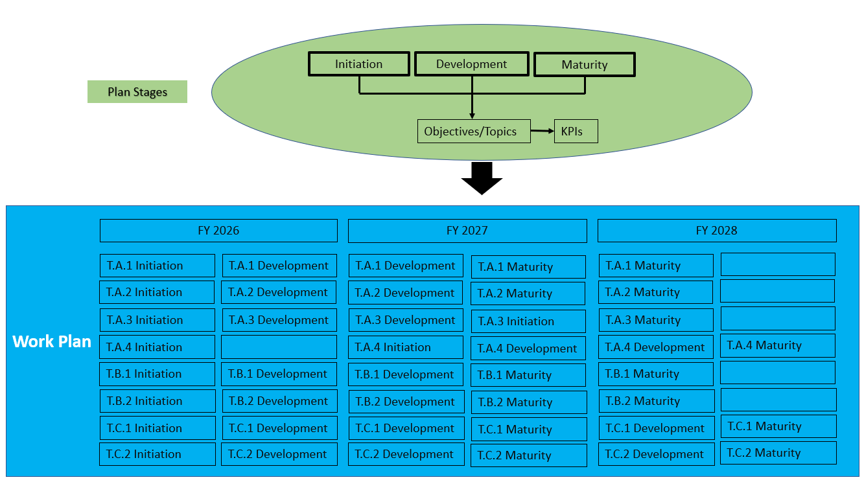
Technology Plan
FY 2026 – FY 2028
Vision
To lead in transforming education by leveraging technology and fostering innovation to create a resilient, inclusive, and data-driven ecosystem. Through robust infrastructure, proactive risk management, and continuous improvement, we strive to enhance learning experiences, empower every student and stakeholder, and ensure sustained excellence at Ridgewater.
Objectives
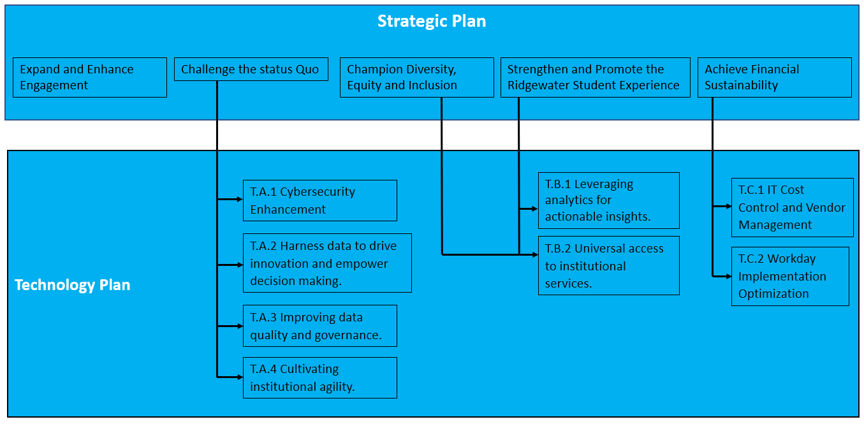
Student Experience (Strengthen and promote)
- Leveraging analytics for actionable insights to improve learning and student success.
- Providing universal access to institutional services by developing and/or supporting multi-modal channels to individualized services and learning experiences.
Operation (Challenge the status quo)
- Minimize the institutional risk by strengthening cybersecurity.
- Improving data quality and governance.
- Harness data to drive innovation and empower decision making for continuous improvement.
- Cultivating institutional agility.
Finance (Achieve Financial sustainability)
- With Workday being implemented, focus on streamlining processes, data, and technologies.
- Taking control of IT cost and vendor management
Alignment with Strategic Plan
Executive Summary
The plan is aimed to:
- enhance student experiences,
- promote accessibility,
- ensure operational efficiency, and
- achieve financial sustainability within the institution.
Student Experience Enhancement and Promoting Universal Access:
T.B.1 Leveraging Analytics
Data Collection and Integration: Identify and consolidate relevant data sources for student analytics.
KPI Definition and Measurement: Collaborate to establish measurable indicators and benchmarks for student success.
Data Analysis and Visualization: Utilize analytics tools to interpret data and create visualizations for stakeholders.
Predictive Modeling and Intervention: Develop models to forecast outcomes and proactively intervene for student support.
Continuous Monitoring and Professional Development: Establish feedback loops and provide training on data utilization.
Ethical Data Use and Privacy Protection: Ensure compliance with privacy regulations and maintain data security.
T.B.2 Universal Access to Institutional Services
Multi-Modal Access Development: Assess services, develop accessible channels, and integrate technology platforms.
Accessibility Compliance and Training: Ensure digital platforms adhere to accessibility standards and provide training.
Promotion, Feedback, and Collaboration: Market services, gather feedback, and collaborate to enhance accessibility.
Continuous Evaluation and Improvement: Regularly assess accessibility and adapt strategies based on student needs.
Operational Efficiency:
T.A.1 Cybersecurity Enhancement: Conduct risk assessments, implement policies, and provide training to mitigate cyber threats.
T.A.2 Data Quality and Governance: Assess data quality, establish governance frameworks, and ensure compliance.
T.A.3 Innovative Data Utilization: Integrate data sources, analyze insights, and leverage data for decision-making.
T.A.4 Institutional Agility Cultivation: Develop strategic plans, adapt governance structures, and foster collaboration.
Financial Sustainability:
T.C.1 Workday Implementation Optimization: Streamline processes, configure Workday, and ensure effective change management.
T.C.2 IT Cost Control and Vendor Management: Analyze costs, negotiate contracts, and optimize IT spending.
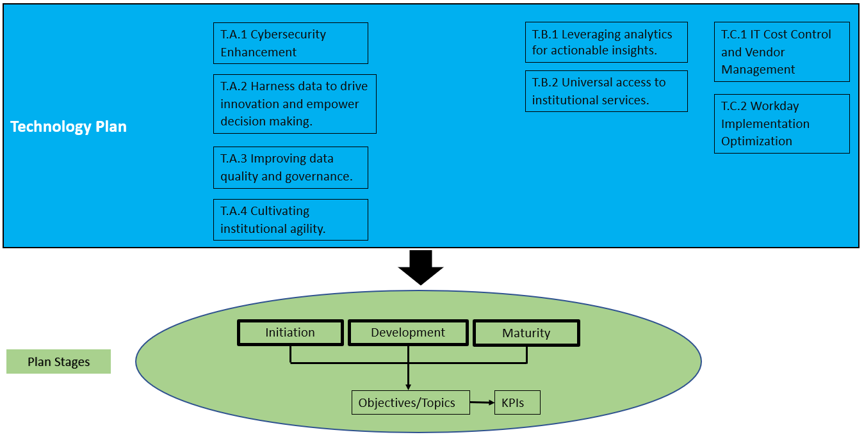
Plan Stages
T.B.1 Leveraging Analytics for Actionable Insights
| Focus Area | Initiation | Development | Maturity |
|---|---|---|---|
| Data Collection and Integration | Identify data sources; consolidate data into a centralized repository. | ||
| Defining Key Performance Indicators (KPIs) | Define measurable KPIs with stakeholders; establish benchmarks and targets. | ||
| Initial Data Analysis and Visualization | Analyze datasets; create dashboards and reports for stakeholders. | Refine analytics processes; foster a culture of innovation with new technologies. | |
| Professional Development and Training | Train employees on data interpretation and multi-modal channel utilization. | Provide advanced training on predictive modeling; encourage cross-department collaboration. | |
| Advanced Data Analysis and Predictive Modeling | Develop predictive models to forecast outcomes; identify attrition risk factors for proactive interventions. | ||
| Ethical Considerations and Privacy | Ensure compliance with FERPA and strengthen data security measures. | ||
| Ongoing Monitoring and Feedback | Establish mechanisms to monitor and evaluate interventions; collect student and faculty feedback. | ||
| Continuous Improvement and Iteration | Refine analytics processes; foster a culture of innovation with new technologies. | ||
| Comprehensive Evaluation and Reporting | Conduct evaluations; publish a detailed report summarizing progress and lessons learned. |
T.B.1 KPIs
| Focus Area | Initiation | Development | Maturity |
|---|---|---|---|
| Data Collection and Integration | Percentage of identified data sources integrated; number of processes streamlined. | ||
| Defining Key Performance Indicators (KPIs) | Number of KPIs defined; percentage of benchmarks and targets established. | ||
| Initial Data Analysis and Visualization | Number of dashboards/reports created; stakeholder satisfaction with visualizations. | ||
| Professional Development and Training | Number of training sessions conducted; percentage of employees’ participation. | Number of advanced training sessions conducted; measurable improvements in employees use of predictive analytics. | |
| Advanced Data Analysis and Predictive Modeling | Accuracy of predictive models; number of interventions implemented based on insights. | ||
| Ethical Considerations and Privacy | Percentage compliance with FERPA; number of security incidents involving student data. | ||
| Ongoing Monitoring and Feedback | Number of feedback responses collected; rate of improvement in student satisfaction scores. | ||
| Continuous Improvement and Iteration | Number of analytics processes refined; adoption rate of new technologies. | ||
| Comprehensive Evaluation and Reporting | Timeliness and quality of the final report; stakeholder feedback on its relevance and insights. |
T.B.2 Providing Universal Access to Institutional Services
| Focus Area | Initiation | Development | Maturity |
|---|---|---|---|
| Multi-Modal Channels Assessment | Assess existing services; begin developing online portals, mobile apps, chatbots, and Zoom kiosks. | Fully implement multi-modal channels; integrate platforms with single sign-on (SSO) solutions. | Evaluate and improve multi-modal channels; collaborate with diversity and accessibility offices. |
| Accessibility Compliance | Audit digital platforms for WCAG 2.0 compliance; provide alternative formats and assistive technologies. | ||
| Promotion and Awareness Campaigns | Launch marketing campaigns and orientation sessions to promote services. | ||
| Accessibility Enhancements | Evaluate and improve multi-modal channels; collaborate with diversity and accessibility offices. | ||
| Collaboration and Stakeholder Engagement | Deepen partnerships with stakeholders and leverage best practices from other institutions. | ||
| Future Planning | Develop a roadmap for sustained progress and explore emerging technologies. |
T.B.2 KPIs
| Focus Area | Initiation | Development | Maturity |
|---|---|---|---|
| Multi-Modal Channels Assessment | Completion rate of service gap assessment; development progress of initial multi-modal channels. | ||
| Accessibility Compliance | Percentage of platforms audited for WCAG compliance; number of assistive tools provided. | ||
| Expanded Multi-Modal Channels | Number of students reached; utilization rate of new services. | ||
| Promotion and Awareness Campaigns | Number of marketing campaigns conducted; percentage increase in student awareness of services. | ||
| Accessibility Enhancements | Percentage increase in service usage by underrepresented groups; student satisfaction with accessibility features. | ||
| Collaboration and Stakeholder Engagement | Number of partnerships established; outcomes of joint initiatives with stakeholders. | ||
| Future Planning | Percentage of identified opportunities for innovation addressed in the new roadmap. |
T.A.1 Cybersecurity
| Focus Area | Initiation | Development | Maturity |
|---|---|---|---|
| Risk Assessment | Complete baseline risk assessment with third-party vendor and System Office guidance. | Prioritize risks and implement mitigation plans for critical vulnerabilities. | Perform follow-up assessments to validate mitigation effectiveness and update risk registers. |
| Cybersecurity Policies and Procedures | Draft initial policies for cybersecurity roles, incident response, and compliance. | Conduct institution-wide review and training on new policies; establish routine update schedule. | Finalize policy implementation; conduct audits for adherence and revise policies based on emerging threats and feedback. |
| Employee Training | Launch awareness programs targeting phishing, password security, and basic cyber hygiene for all employees. | Expand training topics and simulate phishing tests; begin tracking attendance and compliance rates. | Review mandatory annual cybersecurity training; showcase metrics improvement. |
| Network Security Measures | Deploy essential tools: firewalls, IDPS, and regular patching protocols. | Expand network segmentation and conduct penetration testing to identify weak points. | Optimize network security through analytics; build real-time threat monitoring system. |
| Endpoint Protection | Introduce EDR tools and enforce encryption and MDM policies. | Increase endpoint management capabilities and check on the possibility of extending coverage to BYOD devices. | Conduct an audit of endpoint compliance and enforce upgrades based on latest threat trends. |
| Data Encryption and Access Controls | Encrypt critical assets and implement least privilege principles for sensitive areas. | Expand encryption protocols to cover broader datasets and audit access control compliance. | Transition to a zero-trust model with advanced access verification and anomaly detection. |
| Incident Response Planning | Draft incident response plan and conduct initial training and tabletop exercises. | Refine the plan based on initial drills; simulate ransomware attack scenarios for readiness testing. | Fully operationalize incident response plan with system-wide adoption; conduct regular stress-tests. |
| Collaboration and sharing | Join CISO and CIO advisory meetings and participate in local cybersecurity groups. | Share threat intelligence and best practices; build collaborative relationships with peer institutions. | Institutionalize partnerships and information-sharing agreements for rapid response capabilities. |
| Continuous Improvement | Establish a review cadence for cybersecurity policies and controls to align with regulatory updates. | Adapt technologies and frameworks to match evolving cyber threats. |
T.A.1 KPIs
| Focus Area/Year | Initiation | Development | Maturity |
|---|---|---|---|
| Cybersecurity | - Completion of baseline risk assessment (100%). - ≥80% of employees trained in cybersecurity awareness. - 5–10 policies drafted and approved. - ≥90% deployment of critical tools. | - Reduce critical vulnerabilities by 50%. - Endpoint management coverage ≥85%. - Conduct 2–3 phishing simulations. - Decrease incident response times (baseline vs end-of-year). | - Conduct ≥3 successful incident response exercises. - Achieve ≥95% compliance with policies. - Encrypt 100% of sensitive data. - Improve cybersecurity risk score by 25%. |
T.A.2 Data Quality and Governance
| Focus Area | Initiation | Development | Maturity |
|---|---|---|---|
| Data Quality Assessment | Conduct baseline data quality audit and define metrics for improvement. | Address critical issues and develop benchmarks for key datasets. | Implement continuous quality monitoring with automated reporting. |
| Data Governance Framework | Establish roles, responsibilities, and policies for data governance. | Train data stewards/owners and build formal review committees. | Optimize processes with feedback loops and integrate governance into institutional culture. |
| Data Quality Improvement Initiatives | Prioritize and execute initial data cleansing and deduplication projects. | Address intermediate data issues and track improvement metrics. | Finalize systemic improvements and showcase measurable data quality gains. |
| Data Privacy and Security | Begin addressing compliance gaps with GDPR, FERPA, and other regulations. | Roll out encryption and anonymization measures for sensitive datasets. | Conduct regular compliance audits and build real-time privacy monitoring dashboards. |
| Training and Awareness | Launch data governance awareness sessions and training for key employees. | Expand training scope to include all data-handling roles. | Institutionalize annual training as part of onboarding and employee evaluation. |
T.A.2 KPIs
| Focus Area/Year | Initiation | Development | Maturity |
|---|---|---|---|
| Data Quality and Governance | -Complete data quality assessment (100%) - Fill 100% of governance roles. - Establish ≥70% clean/accurate data baseline. | - Improve critical data quality metrics by ≥15%. - Cover ≥80% key datasets with governance framework. - Resolve all compliance gaps. - Train ≥90% of governance roles. | - Meet ≥90% of data quality benchmarks. - Implement ≥15 automated validation checks. - Achieve 100% compliance with privacy regulations. |
T.A.3 Harness Data for Innovation
| Focus Area | Initiation | Development | Maturity |
|---|---|---|---|
| Data Inventory | Identify and document all critical data sources; assess relevance and gaps. | Prioritize datasets for analytics and quality improvement. | Fully integrate data inventory into operational workflows. |
| Define KPIs | Work with stakeholders to identify KPIs; draft initial dashboard designs. | Refine KPIs based on stakeholder feedback; track initial trends. | Institutionalize KPI dashboards and align with strategic planning processes. |
| Data Analysis and Visualization | Pilot initial dashboards and visualization tools to showcase insights. | Refine tools and expand use cases; introduce predictive analytics. | Operationalize predictive models and transition to prescriptive analytics for decision-making. |
| Collaboration and Feedback | Establish cross-functional teams for initial analytics use cases. | Facilitate regular feedback sessions and iterate on insights. | Formalize cross-functional collaboration with dedicated innovation teams. |
T.A.3 KPIs
| Focus Area/Year | Initiation | Development | Maturity |
|---|---|---|---|
| Harness Data for Innovation | - Inventory 100% of critical data sources. - Provide ≥50% of stakeholders with KPI dashboards. - Achieve average dashboard usability score ≥4/5. | - Implement 2–3 advanced analytics models. - Refine and operationalize ≥70% of KPIs. - Achieve average stakeholder satisfaction ≥4/5 for data-driven solutions. | - Enhance ≥90% of institutional processes using analytics insights. - Integrate ≥50% of prescriptive analytics into decisions. - Improve strategic goal achievement by 20%. |
T.A.4 Institutional Agility
| Focus Area | Initiation | Development | Maturity |
|---|---|---|---|
| IT Strategic Planning | Develop a technology strategy emphasizing agility; share with key stakeholders. | Begin implementing agile-focused objectives and conduct quarterly reviews. | Fully integrate agility metrics into institutional evaluation frameworks. |
| Agile Governance | Pilot Scrum and Kanban methodologies in select departments. | Expand agile practices institution-wide and evaluate effectiveness. | Embed agile frameworks into everyday operations; measure efficiency improvements. |
| Empowerment and Talent Development | Begin agility and adaptability training for leadership teams. | Offer employees-wide training on agile practices and encourage experimentation. | Incorporate agility as a core competency in performance reviews and leadership development. |
T.A.4 KPIs
| Focus Area | Initiation | Development | Maturity |
|---|---|---|---|
| Institutional Agility | Institutional Agility - Complete IT agility strategy (100%). - Pilot agile methodologies in ≥3 departments. - Train ≥60% of employees on agility. | - Adopt agile methodologies in ≥50% of departments. - Reduce project delivery times by ≥25%. - Achieve average employees satisfaction ≥4/5 for agility practices. | - Utilize agile methodologies in ≥90% of operations. - Increase cross-departmental collaboration by 20%. - Achieve ≥2 case studies showcasing agility-driven success. |
T.C.1 Streamline Processes with Workday
| Objective | Initiation | Development | Maturity |
|---|---|---|---|
| Conduct comprehensive process mapping | - Initiate review of existing processes- Document workflows and identify bottlenecks | - Implement findings from process mapping- Establish roles and responsibilities | - Continuously refine and optimize workflows |
| Align with Workday capabilities | Understand Workday features- Identify opportunities for efficiency | Align processes as needed in Workday- Leverage automation and self-service features | - Monitor and measure the impact of implemented features |
| Customize and configure Workday | - Collaborate with the System Office to determine customization needs | - Execute approved customization- Document configurations for future reference | - Evaluate effectiveness of configurations |
| Manage data migration and integration | - Train IT employees on APIs and data exchange- Migrate pilot data sets | - Complete full data migration- Validate and troubleshoot integration issues | - Optimize data flows and maintain consistency |
| Change management and training | - Develop a communication plan- Coordinate role-specific training | - Conduct training sessions and provide ongoing support | - Gather feedback and refine training programs |
| Process automation and optimization | - Identify areas for automation | - Implement automation for high-impact processes | - Expand automation efforts and monitor results |
| Ensure data governance and quality assurance | - Collaborate with System Office to define governance policies- Develop data quality controls | - Implement governance policies and controls- Perform quality audits | - Refine policies and address gaps |
| Promote collaboration and knowledge sharing | - Join system-led communities of practice | - Actively participate and share learnings | - Lead initiatives to enhance knowledge sharing |
T.C.1 KPIs
| Category | Initiation | Development | Maturity |
|---|---|---|---|
| - Process Mapping Completion Rate: % of business processes reviewed and documented. - Workday Alignment Gap Analysis: % of gaps identified. - Customization Feasibility Analysis: % of needs addressed by planned configurations. - Training Completion Rate: % of IT employees trained on APIs. - Governance Policy Draft Completion: % of policies defined. | - Process Adoption Rate: % of departments using configured workflows. - Automation Implementation Rate: % of high-impact processes automated. - Data Migration Accuracy: % of data migrated with minimal errors. - Training Effectiveness Score: Post-training survey average score. - Governance Policy Adherence: % adherence to policies. - Community Participation Level: Frequency of system group engagement. | - Workflow Efficiency Improvement: % reduction in process cycle times. - Workday Feature Utilization: % of implemented features actively used. - Stakeholder Satisfaction: Average satisfaction score in surveys. - Automation Coverage Expansion: % increase in automated processes. - Data Quality Improvement: % decrease in data errors. - Knowledge Sharing Initiatives: Number of sessions hosted. |
T.C.2 Control IT Costs and Vendor Management
| Objective | Initiation | Development | Maturity |
|---|---|---|---|
| Conduct comprehensive cost analysis | - Review current IT costs- Identify inefficiencies and opportunities | - Implement recommendations to address inefficiencies | - Evaluate cost-saving measures for sustained impact |
| Establish an IT budgeting process | - Define IT budget categories- Align budget with institutional priorities | - Implement budgeting workflows- Monitor adherence to budget | - Refine budgeting process based on stakeholder feedback |
| Perform vendor assessment and rationalization | - Evaluate current vendors- Identify overlaps and redundancies | - Consolidate vendors- Negotiate better pricing | - Monitor vendor performance and contracts |
| Improve negotiation and contract management | - Develop negotiation strategies- Review contracts with legal and IT security | - Finalize favorable contracts- Implement tracking tools for contract management | - Conduct regular contract audits |
| Enhance cost transparency and accountability | - Develop mechanisms for cost tracking and reporting | - Implement cost allocation methodologies | - Publish transparent cost reports for informed decision-making |
| Optimize usage and demand management | - Analyze IT usage patterns- Identify areas for optimization | - Implement demand management practices- Monitor resource utilization | - Evaluate outcomes and adjust strategies |
| Conduct benchmarking and cost comparison | - Gather benchmarking data- Assess competitiveness of IT costs | - Utilize data to negotiate better vendor terms | - Regularly compare costs against peer institutions |
| Optimize licensing and asset management | - Implement software asset management practices- Conduct license audit | - Use license optimization tools to eliminate unused licenses | - Continuously monitor and optimize license utilization |
| Establish governance and oversight for cost management | - Form governance committees- Develop cost management policies | - Monitor governance adherence- Evaluate committee effectiveness | - Refine governance structure to meet evolving needs |
| Enable continuous improvement and review | - Initiate regular cost reviews and audits- Develop mechanisms to track progress | - Adjust initiatives based on review findings | - Promote a culture of continuous improvement in cost management |
T.C.2 KPIs
| Category | Initiation | Development | Maturity |
|---|---|---|---|
| - IT Cost Baseline Established: Comprehensive documentation of IT costs. - Vendor Evaluation Rate: % of vendors evaluated. - IT Budget Draft Completion: % of budgeting framework completed. - Cost Tracking Implementation: % of mechanisms implemented. - License Audit Coverage: % of licenses audited. | - Cost Reduction Achieved: % reduction in IT costs from baseline. - Budget Utilization Accuracy: Variance between planned and actual IT budget. - Vendor Consolidation Rate: % reduction in vendor count. - Favorable Contract Terms Secured: % of renegotiated contracts. - Resource Utilization Efficiency: % improvement in resource usage. - License Optimization Effectiveness: % reduction in redundant licenses. | - Sustained Cost Savings: Total savings since Year 1. - Budget Accuracy: % of budgets executed without variance. - Vendor Performance Score: Average performance rating. - Contract Renewal Optimization: % of contracts renewed with favorable terms. - Demand Management Efficiency: % improvement in resource allocation. - License Compliance Score: % compliance with agreements. - Governance Structure Efficiency: Stakeholder evaluation of governance effectiveness. |
Aligning with Annual Work Plan